Society is at risk from journalism cuts

Journalism is shrinking in plain sight and the scale of the collapse is far larger than most people realise. In the UK and US alone, more than 3,400 journalism jobs disappeared in 2025, according to the journalists’ trade magazine Press Gazette.

Entire newsrooms have been hollowed out, with January 2026 alone seeing nearly 1,000 layoffs.

These figures capture only the cuts large enough to be publicly announced; the real number is almost certainly higher. And the trend is not confined to digital‑only outlets or small local papers. Legacy broadcasters, national publishers, and global news organisations are all shedding reporters, editors, photographers, and producers at a pace that would have been unthinkable a decade ago.

The Washington Post’s decision to lay off more than 300 journalists, nearly a third of its newsroom, shows how deep the crisis has become.

A paper once defined by its global reporting and local accountability is closing its sports section, shrinking its metro desk, cutting international bureaus, and eliminating its daily news podcast. Entire teams were dismissed in minutes, including even correspondents reporting from war zones.

Leadership framed the cuts as a “necessary response” to falling traffic and a changing media landscape, but the result is unmistakable: fewer reporters covering fewer stories for fewer people.

What’s being lost is not just jobs. It’s the infrastructure that allows a society to understand itself. When local reporters disappear, corruption grows in the dark. When international bureaus close, global crises become remote, abstract things.

When investigative teams shrink, powerful institutions face less scrutiny. And when newsrooms are forced to chase scale rather than depth, public debate becomes thinner, louder, and easier to manipulate.

The damage is cumulative and largely invisible, until it isn’t. We may not feel the loss of a laid‑off reporter today, but we will feel the consequences when misinformation fills the gaps, when communities lose their watchdogs, and when democratic institutions weaken without anyone noticing.

Journalism is not just another industry in decline. It is a public good, and its erosion is a slow‑moving crisis that affects all of us, whether we’re paying attention or not.

Photo by Marek Pospíšil on Unsplash
Why the Mandelson and Andrew footage is so compelling

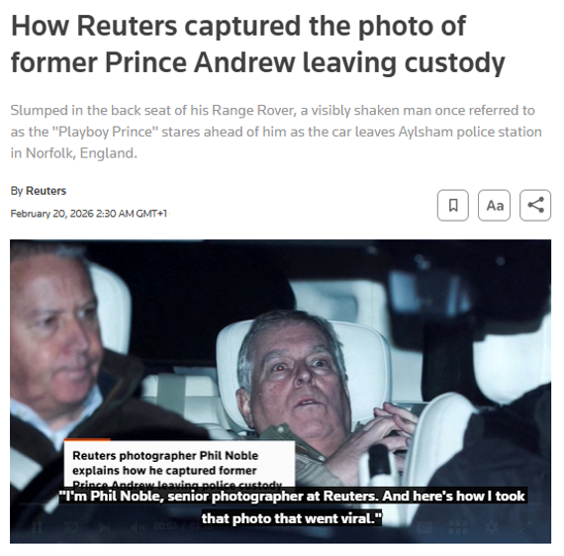
There’s something undeniably gripping about the recent clip of Britain’s former US ambassador Peter Mandelson being arrested and the Reuters photo of Andrew Mountbatten‑Windsor returning home from the police station. It isn’t just the shock of seeing two establishment figures caught in moments of acute vulnerability.

It’s the fact that Britain, a country that prides itself on discretion and due process, has stumbled into something resembling the American perp walk, that strange ritual where the accused is paraded before the cameras, handcuffed and flanked by officers, as if shame were part of the judicial process.

That’s not really the done thing in the UK. British justice normally prefers quiet corridors, closed doors and the gentle hum of paperwork.

But the sight of Mandelson being led away, or Andrew being driven along in a car with the unmistakable look of a man who has just spent several hours answering questions he’d rather not, taps into a deep cultural curiosity. These are people who have spent their lives insulated from scrutiny. Seeing them suddenly exposed feels like a crack in the façade of power.

The American perp walk is designed to send a message: no one is above the law, and the public has a right to witness accountability. It’s theatre, of course, carefully choreographed, often criticised, but undeniably effective.

In the UK, the legal system tends to recoil from such spectacle. Yet when it happens accidentally, as it has here, we can’t look away. The footage feels illicit, like we’re seeing something we’re not supposed to. It’s the contrast that makes it compelling: the grandeur of their former lives colliding with the spectre of legal consequence.

What these moments reveal is how powerful visual accountability can be. A written statement can be parsed, spun or ignored. But a man stepping out of a police station at dusk, shoulders tight, eyes fixed on the ground? That image lingers. It tells a story no press release ever could.

The Uxbridge connection

boris
The last time I met the sitting MP for Uxbridge was in 1988 while a politics student at nearby Brunel University. Michael Shersby, the then Parliamentary representative for our local constituency, generously hosted Brunel’s annual Government Society dinner at the House of Commons, and arranged an array of guest speakers.

One year, we were fortunate to have the Speaker, the then Bernard (later Lord) Weatherill, who came to talk about democracy and the importance of being actively involved.

On another occasion, sharing the evening with the local Conservative Association, we were slightly less impressed by Minister of Education Angela Rumbold. Possibly labouring under the misapprehension that we were the University’s Conservative Students Group, she decided to lecture us about how the Tories were ‘good for education’. Continue reading